Art, Transcendence, and the fabric of reality
In More than Allegory, Bernardo Kastrup advances the intriguing proposition that reality is a realm of pure form, and that myth constitutes the portal through which access to what he defines as 'transcendent truth' may be possible.
Ironically, Bernardo's thesis could easily be interpreted as defying the so-called paramount achievement that is identified with the birth of philosophy and thus science: the transition from Mythos to Logos.
As the reader will probably know, this processual event is widely portrayed as the overcoming of mythical and religious narratives by the advent of rational thought —the logos—, which turned into the fundamental means to both interpret and explain the cosmos.
Despite the historical veracity of this account, if analyzed with rigour, it appears as an oversimplification that reduces, through its exclusiveness, the connotative power of myth as a valid gateway to some sort of truth.
To put it plainly, by elevating reason to the status of not only absolute but also exclusive authority, with regard to the apprehension and explanation of truth, myth is consequently relegated to epistemological uselessness.
In other words, as the implicit statement declares, every narrative alien to logic and intellectual analysis must simply be discarded as a source of either meaningful or reliable knowledge about reality.
Nevertheless, the question that arises is whether truth —if even attainable— is to be understood as monohedral rather than polyhedral. And, congruently, one should further ask whether the path to approach that a priori indeterminable object is also unique.
In response to this dilemma, Kastrup proposes an interesting division of truth into three categories: the literal, the allegorical, and the transcendent.
On this basis, he states a critical observation which connects with the above. Specifically, he refers to the far-fetched assumption that "all relevant truths about reality can be directly captured by the intellect in the form of language constructs".
The consequence of that seemingly limiting perspective we chose to embrace delimits an equally confined field of epistemological potentiality.
In other words, if language is the only way to signal truth, anything that appears undefinable through language —in any of its multiple instances— is not susceptible to reason, and must therefore be untrue.
In fact, as Bernardo affirms —in reference to Chomsky and particularly to Abelard— "our reasoning and our language overlap and co-define each other".
But what if the constraints of the intellect conceal the apprehension of a truth that lies beyond reason?
Assuming that possibility, what if the means to relate to that particular type of truth —namely, a transcendent truth— escaped the domain of the intellect and, moreover, of personal consciousness?
This is how we come to what Bernardo defines as 'the obfuscated mind'. According to his thesis, the unconscious parcel of the mind is nothing but an 'obfuscated part of consciousness'. —Therefore, there is no unconscious, technically speaking—.
The compelling implication of the foregoing is that linguistic structures —as psychology reveals— are not reconcilable with the operational framework of the unconscious mind. Indeed, the information processing we find in that area of the psyche responds to a different kind of code —neither logical, nor grammatical, nor algorithmic—. Instead, the default mode of the obfuscated mind is purely symbolic.
This brings us to our cardinal proposal: to elucidate the viability of art as a potential thread leading to transcendence.
For this purpose, we will ground our explanation both in the foregoing and in the arguments developed throughout our previous essay, "The Nature of the Human Conatus".
In accordance with our previous essay's thesis, we can understand reality as fundamentally subjective and therefore empirical. Subsequently, this continuing process —occurring within the ontological substrate of consciousness— unfolds through a bipolar ramification defined by the actions of creation and discovery.
Now, the processual compound of those two elements —which co-act reciprocally— delivers the instantiation of a story within the fabric of reality. In effect, consciousness would thus be co-creating and co-discovering itself through its multiple manifestations, and while infinite potentials actualize into existence, a continuous narrative will be written in aeternum.
That being said, if existence is experiential —both from a phenomenal and from an ontological point of view— and every experience entails the substantiation of a narrative, one could argue that, in essence, everything is predicated by narration.
Returning to Bernardo's insights, he characterizes myth precisely as "a story that implies a certain way of interpreting consensus reality"; moreover, he boldly postulates the possibility of a particular class of mythical construction —i.e., religious myth— as "the most direct and accurate utterance of transcendent truths".
However, is religious myth the single path to what resides beyond the realm of the rational? In fact, what is it, if not a particular form of narrative?
Hereof, one could argue that narratives are implicit in any kind of aesthetic or artistic expression, since every work of art is, essentially, the transmission of a message that betrays the hidden story dwelling within the artist's "soul".
Because of it, we could then establish a parallelism between the narrative which is actually imprinted in the object and that which inspires the artistic production per se.
Accordingly, it seems questionable that in the case of art, narrative can be assimilated to a mental construct framed on behalf of providing coherence to our inner narrative and thus self-concept.
This leads us to an intricate dilemma: either narratives are generated by personal subjectivity, or they genuinely exist within the setting of reality. If part of its ontological tissue, this could be sustained by relating such a claim to the empirical nature we attribute to existence.
Moreover, if we concede that reality is essentially processual, narrativity must escape the confinement of individual mentation. It simply cannot be reduced to a mental formulation; instead, it must exist —parallel to what spawns in mind— as a true ontological correlate of the phenomenal world. That is, to the development of events that sequentially precipitate through the actualization of potentials.
So, what we are trying to indicate is that even though subjective experience is undoubtedly structured as a narrative that we, humans, relate to any potential time —present, past, or future—, the apparent processuality of nature's behaviour implies the possibility of it being narrative.
Admittedly, this perspective clashes with Bernardo's, since he firmly denies the existence of time outside the cognitive content of the human mind. In fact, past and future are defined as mere projections that derive their storytelling from the timeless attributes of the present — a singularity which, intangible as it is due to its extreme ephemerality, contains all existence.
From an epistemological point of view, this again seems indisputable. Indeed, our connatural conditioning is nothing but categorical. Nonetheless, this does not necessarily suggest that time resides solely in the mind's computational system.
By following Kant's metaphysical dichotomy, phenomenal information is incapable of revealing the underlying truth of the noumena. Hence, since perception is clearly embedded in subjectivity, how can we discard, with no margin for error, that processuality, hence movement, and therefore time, exist outside subjective apprehension?
Furthermore, if subjectivity is all there is —for existence is a continuous course of unfolding wherein consciousness experiences itself through creation and discovery—, time could thus be a consubstantial quality of reality. Certainly, why couldn't 'mind at large' cognize itself in the same manner as we —individuated conscious beings— do, or at least analogously?
In other words, despite reality being elusive and the substantiation of existence appearing as a faculty of our meaning-making mind, this does not prove the timeless stasis of reality. On the contrary, if we are but expressions —or dissociated alters— of the whole and unique ontological substance, why not extrapolate our own way of experiencing —and thus the previously alluded faculty— to that of the ultimate expression of reality?
In accordance with Bernardo, we must assume that the concept of an external world independent of consciousness —and hence objective— is just a metaphysical abstraction, a hypothesis that will remain unverifiable. Still, a similar argument could be made with regard to our own inference of reality.
To further elaborate on this point, we could argue that for all we know and can ever know —congruent with our personal experience as cognitive-perceptual beings— the world might be inherently mental.
Once the idea of an objective reality outside consciousness is abandoned, and being the qualities of individual experience potentially equated to those of the omnimodal mind, our argument could be disputed by the affirmation that mind only emerges from a highly complex and contingent disposition of matter, namely, the brain.
Under analytic idealism, the living body —and hence the brain— is "what our mental inner life looks like when observed from an outside perspective".
Based on that premise, one could insist on refuting us by stating that the cosmos' scaffolding should thus resemble the intricate arrangement we find in the brain's perceivable architecture.
Well, in a 2020 study published in Frontiers in Physics, Italian astrophysicist Franco Vazza and neurosurgeon Alberto Feletti conducted a quantitative comparison between the human brain's neuronal network and the large-scale structure of the Universe, known as the cosmic web.
While acknowledging several methodological limitations and the radically different physical processes involved, the authors found striking structural similarities between the two systems. Despite a difference in scale of 27 orders of magnitude, both networks exhibit notable parallels in density distribution — with approximately 30% of the mass concentrated in dense nodes and filaments — clustering properties, and overall topological complexity.
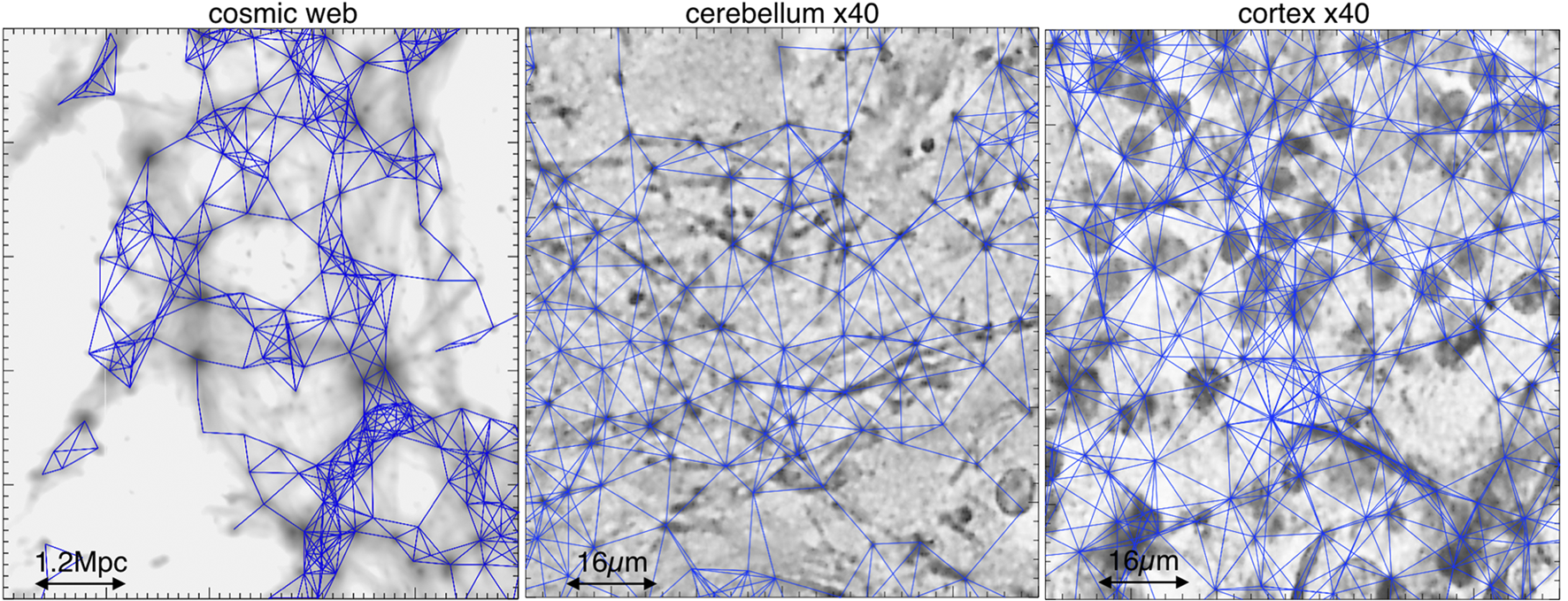
They also noted a curious proximity in their estimated information storage capacity (~2.5 Petabytes for the human brain versus ~4.3 Petabytes for the cosmic web), although this comparison remains highly approximate.
Bewildering as the observations appear to be, we must attest to the epistemological honesty of the authors and —regarding the limitations of their research— emphasize the necessity to perform further studies in order to validate their results.
Be that as it may, the actuality of the observable, and thus the experiential —though far from constituting an indisputable piece of evidence— hints at the plausibility of our thesis.
Returning to the argument, if reality is essentially experience, there must be an experiencer and an object of experience.
So, if we dispose of that ontological duality, it virtually means that either the subject is experiencing itself, hence becoming both subject and object —that is, an objectified subject or a subjectified object— or that there is neither.
In this last scenario, the integral substance of existence would thus be an unintelligible fluid of experience. Consequently, there would be no knower and nothing to be known, just the pure "knowing".
Such a claim is indeed reminiscent of William James's 'pure experience' metaphysics, where mind and matter are simply aspects of, or structures constituted by, a neither mental nor physical stuff —the ontological fundament— that he defines as 'pure experience'.
According to the foregoing, this unqualifiable substance that we postulate as fundamental will thus be non-dual. A sort of formless and attributeless presence, resembling the most categorical version of subjectivity conceivable.
In spite of certain nuances we will not address at the moment, since they exceed the scope of our exposition, we should notice how suitably the previous description converges with the advaitic notion of Brahman. A portrayal which is openly expounded in Adi Śaṅkarācārya's Upadeśa Sāhasrī, as he postulates, for instance, in Chapter X.1: "I am the Supreme Brahman which is pure consciousness, always clearly manifest, unborn, one only, imperishable, unattached and all-pervading, like the ether and non-dual. I am, therefore, ever-free."
It is evident that in following the preceding assumption, however, we succumb to a circular recursion: if subjectivity implies self-experience, and if experience is all there is, the only potential to be fulfilled by the subject —in this case, humans— is to experience themselves.
Subjectivity, as we mentioned, thus becomes the single field of experience, and therefore, of reality.
By relating this premise to our previous exposition, we will now inquire from a subjective perspective:
If reality is self-referential, wouldn't it be plausible that, while experiencing our own internally lived universe as a present, developing narrative—being, as it is, immanently predicated by the reciprocal compound of creation and discovery—this is exactly what happens at a supra-individual level?
In light of this, if our internal reality is inherently narrative —for that is how it is both construed and processed by the individual mind— and if everything in existence is accepted to be condensed within —analogous to an ontological replica of what is without— why can't this be the case for the unfathomable completeness of reality? In other terms, why can't reality be experiencing itself explicitly as an unfolding narrative?
A valid reply to this would be to sum up the above by declaring that if human experience is fundamentally narrative-mediated, narration must thus be an intrinsic property of experience. And if the latter —i.e., experience— is all that exists, reality itself also needs to be a self-narrative construct, hence reflexively experienced.
Interestingly enough, Kastrup supports this assertion with conviction while depicting the bulk of the world as a collection of narratives experienced in the mind according to linguistic patterns.
The question is whether it is possible to extend our apprehension beyond the narratives flowing inside our internal limits —which, as stated, reflect the potential outer dynamics of reality— in order to successfully reach the transcendent truths that lie within them. Truths that will, by virtue of their equivalence, disclose those that abide in the realm of the absolute. Namely, to link both ethereal instances through a primarily symbolic practice, in a way that also bridges the unconscious with the conscious in the personal mind.
As proposed at the beginning, we presume that art —in its various forms— could embody a potential alternative to religious myths in that double permeation we alluded to before.
Given that religious myth is basically composed in the form of a narrative, it relies on the denotative character of language as a means for its initial perception, thus demanding the intervention of the intellect prior to any deeper apprehension.
This, of course, is independent of the fact that its true significance may rest in its symbolic content, as defended by Kastrup.
As opposed to it, art appears to be different a priori, but to what extent?
It is evident that not every artistic manifestation shares the same format when actualized.
Indeed, whereas literature and poetry also rely on denotation through language in order to connote symbolic meaning, other forms of art, such as painting, sculpting, and music —though the latter being contingently language-based— allow us to bypass the intellect's influence, at least partially, for they are primordially symbolic in their substantiation.
By avoiding the necessity for conceptualization, one could argue that these artistic expressions can more easily penetrate the unconscious by precluding the intellect and directly appealing to instinct and thus to emotion —evidence of this being the unequivocal immediacy of the visceral and affective responses aroused when exposed to artistic stimuli.
As a result, the encounter with artistic forms leads directly to what we denominate a lived or sensed experience.
Let us remember, in this respect, the words of Whitehead, who postulated that "symbolic reference is the interpretative element in human experience" (1929c [1985: 173]).
From a religious or mystical standpoint, what if the elimination of the intellectual factor —or at least its most emphatic reduction— is precisely the clearest, that is, the most unadulterated path to accessing what we might otherwise call the sacred?
In order to comprehend the intricacy of art creation, we will now proceed to analyze its phenomenal occurrence, along with all its ontological correlations.
At the genesis of the artistic emanation, it is the artist who gains access to the truth of his immanence while discovering the presence of transcendence in his internal nature. Such a profound realization happens when the agent experiences a special sort of intuition that kindles the impulse for artistic expression.
Evidently, the pouring of this peculiar animus onto the work of art while moulding its proper form constitutes de facto a process, which itself entails a specific experience and therefore the blooming of a narrative.
Let us consider that it is the crystallization of the artist's 'revelation' —namely, the experience of internal transcendence— that is ultimately imbued in the final aesthetic object.
Consequently, when the recipient is exposed to the work in question, he can potentially experience an extant connection with the transcendence that evenly abides in him. For this to transpire, the transcendent element in the perceiver must be analogous to the one that flared the inspiration in the artist and was infused by him in his piece of art. The connection, nonetheless, will eventually surpass the confinement of the personal frontiers —even though contingent and substantially non-real— binding the transcendent elements within both the artist and perceiver with that residing in the realm of the absolute.
In order to illustrate this with an analogy, imagine both subjects —artist and perceiver— carrying within them an identical quartz crystal tuned to the same ideal frequency.
As the artist forges the piece of art, he inoculates in it that unique vibration and manages to stabilize it inside his creative expression.
When the perceiver approaches the work of art and is presented with the symbolism implicit in it —that is, the language that signals the transcendent truth— his interior crystal activates and starts to vibrate through a sympathetic connection, at exactly the same frequency as that of the artistic creation.
Ultimately, the vibration connects the transcendent truth within the recipient not only with the transcendent truth that the artist encountered within and channeled into the artifact, but with an unfathomable resonance —i.e., a transcendent truth— far beyond the artistic object and himself.
Hence, the artistic piece is neither a crystal nor does it contain one. It simply is the pure means of transmission, the wave itself travelling from one source to the other.
If analyzed empirically —based on first-person experience—, the cited attunement is felt as a factual detachment from the ego and 'consensus reality'. Further, the sense of presentness envelops the person so that subjectivity seems to collapse in itself. Thus, what appears as a process of estrangement or alienation is indeed lived as the embodiment of an uncanny type of wholeness.
In effect, it is in that state that a profound feeling of peace invades our own awareness, blurring the boundaries that purportedly marked our individuality.
Schopenhauer actually proposed something similar when he invoked the idea of ästhetische Anschauung —i.e., aesthetic contemplation. Therein, the individual virtually evaporates and —while discerning the archetypal or 'Platonic Idea' within the object— becomes the pure, will-less, painless, timeless subject of knowledge.
From an ontological view, it is important to stress that the object does not comprise the transcendent truth —which the artist, the perceiver, and reality's fundament alike harbour. In fact, the work of art should be conceived as the actualization of an ontological transcendent element in the phenomenal world.
Therefore, the transcendent truth is formally present in the artistic object, but not substantially. In other words, what we perceive in the work of art is the visible expression of that noumenal truth.
On that basis, the artistic phenomenon is far from being a mere stimulator or a signal repeater. Instead, it is the very form of transcendence, of that particular truth it is vibrating with.
To a certain degree, it is as if the phenomenon had become positively transparent to the noumenal. Something we could arguably define as divine.
As you may notice, we have essentially delineated an experiential flux we will now synthesize in more analytical terms: the process begins with the artist and his connection with his inner transcendence. Indeed, this contact is initially produced by a special insight —purely intuitive and hence emerging from the unconscious— that we commonly define as 'inspiration'. Later, this self-intuited truth is symbolically conveyed in the aesthetic object and hence transmitted to the recipient who, while perceiving the piece of art, is able to capture —also intuitively— the transcendence imbued in it. As the ontological synchronization is established, it promptly ignites the perceiver's realization of his transcendent truth, analogous to that expressed in the object, and thus to the one which resides in the artist.
Graphically speaking, the connection that originates would then appear as a triangular relation between three elements: artist, work of art, and recipient. Yet, is this the complete picture, or have we disposed of something crucial?
Despite having already disclosed the remaining factor of our equation, it may be convenient to remember what analytic idealism postulates about this.
In regard to this metaphysics —and also in line with our previous exposition— ontological individuality is just a mere fiction, a construction of the mind that intends to give meaning to an egoic-based narrative by virtue of the idea of separateness.
Arguably, this fantasy is imbricated in the conception that subjects are fundamentally defined by their physicality, their corporeal expression. Something we have already analyzed and discarded as highly implausible.
Therefore, if we consider the fact that we are but dissociations of the universal substrate —which we identify with consciousness— the transcendence we encounter as immanent in the subject should not be understood as individual. Rather, this ineffable component is essentially a reflection of the transcendent truth of the whole, that is, of the ontological primitive —as denoted by Dr. Iain McGilchrist.
Furthermore, if we assume ourselves to be localized cognitive configurations of mind-at-large, as Kastrup states, this would imply that overcoming our cognitive boundaries would be the sole course to penetrate the fabric of reality where transcendence admittedly dwells.
In this regard, the insights into transcendence we have previously referred to will thus be sensed as perceptions, for they will stem from outside the individual mind — concretely, from the 'obfuscated regions of mind-at-large'.
Then, in order to tap into transcendent reality, we must necessarily rely on our 'obfuscated minds', as they are our inherent factory for intuitive insight formation.
If we compare this to our argument, the connection experienced by the subject shall be extrinsically oriented. Beyond the restrictions imposed by both the intellect and the senses, the unconscious will instantiate an intuitive apprehension of more fundamental aspects of the universal substrate.
Nevertheless, if we agree on our being dissociative expressions of 'mind-at-large' —i.e., consciousness— wouldn't that suggest the possibility of encompassing a symmetrical ontology?
This would be coherent with characterizing —as we already did— the dichotomy between internal and external as fully senseless. Hence, the same logic should apply to the distinction between immanent and transcendent.
Indeed, why should we probe the extrinsic universe when we intrinsically relate to it as an identical replica, at least to a substantial degree? In fact, aren't we humans, inherently, condensed and localized versions of the cosmos, comprising an immeasurable portion of reality?
To a large degree, this metaphysical sameness aligns perfectly with the advaitic notion of the Self, the ātman. According to Advaita Vedanta, there is no difference whatsoever between the Self —erroneously perceived as personal and thus distinct due to Ignorance— and the all-pervading, single and true reality that is Brahman.
This eradication of duality is patently reflected in the words of Adi Śaṅkarācārya in his Upadeśa Sāhasrī in the following statements:
Chapter XV, part II, 21: "The one and the same Self is in all beings, and they are in It just as all beings are in the ether. As by the ether, everything is pervaded by the Self, which is considered to be pure and consisting of the Light of Pure Consciousness."
Chapter XIV.10: "How can an interior, an exterior, or any other thing be attributed to the Self which comprises the interior and exterior, is pure and of the nature of homogeneous Consciousness?"
Overall, if transcendence becomes immanence, then the other shall become the proper. Likewise, while multiplicity dissolves into unity, what nests in the outer vastness may thus inhabit the depths inside.
Bibliography and Sources
Goodman, Russell. "William James." Stanford Encyclopedia of Philosophy (Winter 2021 Edition), Edward N. Zalta & Uri Nodelman (eds.).
Henning, Brian G. "Alfred North Whitehead." Stanford Encyclopedia of Philosophy (Fall 2022 Edition), Edward N. Zalta & Uri Nodelman (eds.).
Kastrup, Bernardo. Analytic Idealism in a Nutshell: A Straightforward Introduction to the Metaphysics of Reality. Winchester, UK: Iff Books, 2024.
Kastrup, Bernardo. More Than Allegory: On Religious Myth, Truth and Belief. Winchester, UK: Iff Books, 2016.
Śaṅkarācārya. The Upadeśa Sāhasrī. Translated by Swami Jagadananda. Hollywood, CA: Vedanta Press, 2023.
Vazza, Franco, and Alberto Feletti. "The Quantitative Comparison Between the Neuronal Network and the Cosmic Web." Frontiers in Physics 8 (2020): 525731.
Wicks, Robert. "Arthur Schopenhauer." Stanford Encyclopedia of Philosophy (Spring 2024 Edition), Edward N. Zalta & Uri Nodelman (eds.).
© Abraham Meghji Ramos 2026. This text is protected by copyright. Citation and partial use are permitted with full attribution to the author and a link to the source. Reproduction without credit or for purposes of appropriation is expressly prohibited.