A Reformulation of the Conatus from an Idealist Perspective

In his seminal work, Ethics, Demonstrated in Geometrical Order, Spinoza employs the term conatus —from the Latin conātus, “effort, endeavour,” impulse, inclination, tendency; undertaking— to account for the effort that every being makes in order to persevere in its own being.
The development of this concept can be found explicitly in Part III, Propositions 6 and 7, of his Ethics, where, according to the Dutch philosopher, “The striving by which each thing strives to persevere in its being is nothing but the actual essence of the thing.”
As Spinoza infers from logic, this power that dwells in each of us springs necessarily from our own nature. This allows us to interpret its manifestation, that is, its factual production, as an apodictic extension of the only thing we are and of what we might become.
It follows that we, as modes of God, are destined to express its attributes through our own being in a very particular way, or perhaps I should say a “personal” one. And although this is explained in the Ethics in connection with our mind, will and appetite, I would like to keep the focus on its conceptual core, that is, on its most rudimentary principle.
Note, then, that in Spinoza the conception of God points to a panentheistic scheme of reality which, in Part I of the Ethics, crystallizes in Proposition 15, where it is argued: “Whatever is, is in God, and nothing can be or be conceived without God.”
This leads us to establish God as the one substance in ontological terms —both indivisible and infinite—which compels us to identify such an entity, beyond any conceptual restriction, with existence itself.
Thus, even though they are modes by virtue of which God’s infinite attributes emerge or are actualized, we humans constitute the expression of each of the infinite and eternal essences that remain contained in God.
What I propose, then, is to extend the Spinozist notion beyond its original horizon and beyond the generic consideration commonly assigned to the conatus as a mere sign of preservation.
This demands a broader treatment, in which the force of being embodies its will to affirmation, with the consequent and unavoidable effect of conservation.
In any case, note that the idea I allude to cannot, therefore, be static or reducible to a deliberate executive course, the product of a conscious striving. However embedded it might be in the limitations that define the life of the subject and that we now identify with our ego.
What I postulate is an immediate impulse whose breath passes through us without encountering resistance and which therefore operates as the conditioning context of all heritable potency.
Something like a fundamental operating system that nature imprints organically in the depths of our being. In other words, a non-negotiable state beyond the control of the mind, insofar as it is integrated into it in a connatural manner.
The subsequent effect is that its functioning defines the phenomenal sphere of what is operative, of what is consequent; that is, of the very unfolding of human potential.
Hence we should not construe this conceptual deviation of the Spinozist conatus as a simple ontological channelling of the infinitely manifold. Even though its roots lie in the single substance that constitutes reality.
On the contrary, what is denoted is a quality intrinsic to Spinoza’s conatus. This implies a singular ontological apparatus that mechanically filters the immeasurable variety of possibilities contained in existence.
From a certain perspective, it is likely that we might come to associate the foregoing with Whitehead’s process philosophy. Let us recall that, according to it, the infinite potentiality lodged in the universe as “eternal objects” is made concrete in “actual entities,” which may be individually defined as the elemental processes of experience.
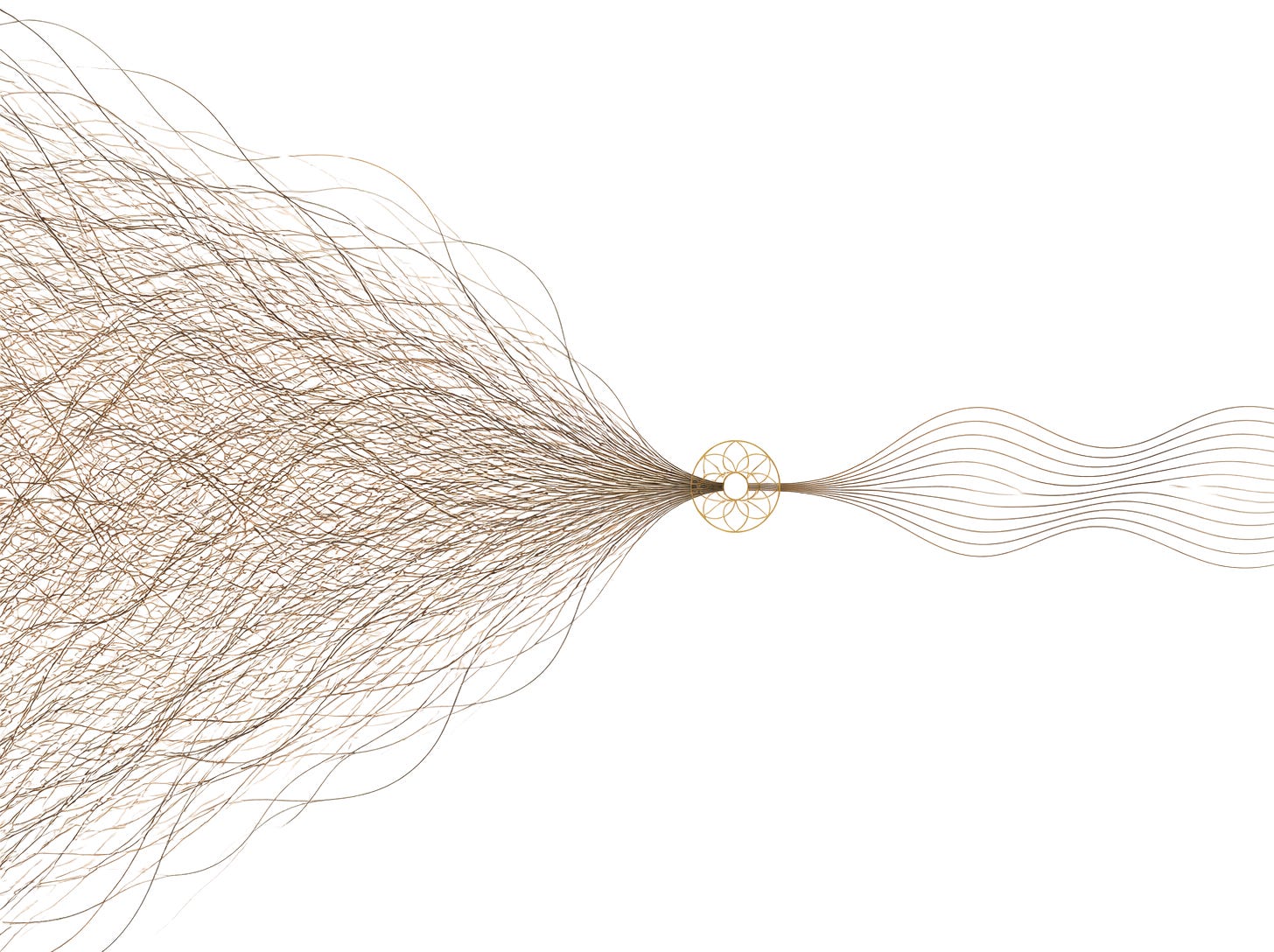
In accordance with our thesis, however, the qualification undergone by those actual entities, owing to the influence of the eternal objects, would be configured innately in their concreative occurrence.
The question at this point should therefore be entrusted to analysing the nature of that inherent structure which is predicated of each parcel of actualization.
To that end, what if our conatus were fundamentally exploratory, insofar as it induces in us a teleological proclivity that takes root to elicit a processual compound formed by two reciprocal elements: the acts of discovering and creating —these being understood as phenomena that occur simultaneously and that are ontologically inherent to one another?
And what is more, this idiosyncratic pattern would have to be subsumed under the category of the empirical, since it constitutes the primordial predicate of subjectivity. Which, in keeping with the current of analytic idealism, could even be considered the very foundation of reality —a move we shall make without proceeding to analyse the theory of reference, since such an undertaking transcends the purpose of this essay.
On the basis of that premise, could we then infer that the aforementioned potentialities are the elemental properties of a universal consciousness, given that their actualization would constitute —according to the chosen framework— the precondition for the unfolding of existence?
Approaching this argument from another angle, the conatus would have to be conceived as absolutely dissociated from every kind of agency, insofar as it intrinsically transcends the terrain of individuality. In fact, its actualization does not depend on intention, will, or appetite, since, to a certain extent, its potential state is unconditionally interwoven with every possible action or inaction.
In order to clarify our position, let us observe that the conatus presents itself as a primordial element of experience, consubstantial with the ontological pillars that sustain reality. All of this, provided that subjectivity is accepted as constitutive fabric.
Consequently, each of the behaviours emanating from the agent —whether active or passive, conscious or unconscious— carries with it the substantiality of discovery and creation.
Note that this points not only to the fact that the most effective stillness, say one occurring in an environment of categorical sensory inhibition, already implies experience, but also that no lived experience whatsoever can lack the dual ontological substrate that has been referred to.
The reason is that as soon as a potency is transformed into phenomenon —whether tangible and thus perceptible, or mental and confined to interiority— creation and discovery become unavoidable for the subject.
This is because they function, basically, as an extension of what we have postulated as the possible ontological primitive, which, as has been noted, might correspond to consciousness or subjectivity per se.
Considering what has been proposed, and thus the apparent ontological prevalence that characterizes humans among other beings —in view of the scope of their potency, not of their essence—, could we conceive the foregoing as a kind of gift, perhaps as a curse, or else, in my own understanding, as a combination of both?
In any case, the understanding of this matter as an anathema could arise for two reasons:
On the one hand, one could argue that our capacity for discovery and creation —preceded by its consubstantial drive— poses an enormous obstacle to embodying the present moment. That is, to living the instant in progress fully.
This argument rests on the fact that the mind is continually seduced by a finalist telos —subordinated to the attainment of goals— which is, in my opinion, branded into our depths.
On the other hand, the generative aspiration is intimately bound up with the need for success, not in a natural sense, which would allude to mere survival, but as regards the social domain. That which, on the psychological plane, translates into a quasi-pathological thirst for validation or recognition.
Unfortunately, the consequence of such a paradigmatic inclination is that, in its most aggressive facet, it disables us from cherishing the genuine value of being as such.
Moreover, the unrestrained tendency toward achievement walks hand in hand with the shadow of ambition, so that it nourishes the potential eruption of what Nietzsche instituted as der Wille zur Macht, the will to power.
Be that as it may, what can we do about it? Do we even have a choice?
Setting aside every intellectual, philosophical, or scientific connotation, I find it futile to question now our deterministic foundation.
In fact, that well of infinite potentiality, though constant in its structure, still endures as a promise of the unfathomable outburst that beats in our creative capacity.
Thus, despite reaffirming our commitment to the pursuit of the good and the truth to the limit of our breath, perhaps the crossroads lies in accepting human nature in its absolute nakedness.
Recalling once more what Spinoza asserted —though interpreted in line with our argument—, it may be that the foundation of virtue is the conatus itself.
And even if we agreed that reason should always act as the guiding principle, what would happen if perseverance in existing were not necessarily akin to the self-preservation of the subject as an individuated entity? What is more, what if creation were the seed of our inescapable and definitive annihilation as the phenomenal expressions that we are?
Perhaps Spinoza was right in laying down in his Ethics, Part IV, Proposition 28, that “The greatest good of the mind is the knowledge of God, and the mind’s highest virtue is to know God.”
But, once again, at what price?
To deny our immanent disposition in favour of moral rectitude is certainly legitimate and, of course, preferable socially. But we should not deceive ourselves into thinking that it will avert the sign of a predictable destiny.
Therefore, if everything in us impels toward discovery and creation, and if it consubstantially implies destruction, inasmuch as each devastation fosters in its consummation a form of genesis —not only in sequential terms and thus in a potential sense, but inherently and in rigour—, is not the total spectrum of our actions an expression of God?
And is not the release of our creative potential the only mandate we can receive from existence and, consequently, the only way of knowing what Spinoza conceived as God?
Just as waves cannot escape the ocean or alter its essential dynamic, neither can we, as mere humans, deny or renounce our true nature and its predicaments.
Thus, so long as reason and courage serve us as beacons, perhaps we must learn to rest in the source to which we belong and which we always inhabit.
Just as waves do, in their returning to the immensity of the deep.
Bibliography and Sources
Spinoza, B., Ethics, Demonstrated in Geometrical Order. Trans. Pedro Lomba. Trotta, 2019. Available at: https://www.trotta.es/libros/etica-demostrada-segun-el-orden-geometrico/9788498797848/
Henning, Brian G., “Alfred North Whitehead”, in Stanford Encyclopedia of Philosophy (Fall 2022 Edition), Edward N. Zalta & Uri Nodelman (eds.). Available at: https://plato.stanford.edu/entries/whitehead/
Translated by Claude Sonet 5.5 AI into English from the original text in Spanish.
Translations from Spinoza’s Ethics into English are the author’s own, based on the Spanish edition referenced above (trans. Pedro Lomba, Trotta, 2019).
© Abraham Meghji Ramos 2026. This text is protected by copyright. Citation and partial use are permitted with full attribution to the author and a link to the source. Reproduction without credit or for purposes of appropriation is expressly prohibited.
Discussion about this post